


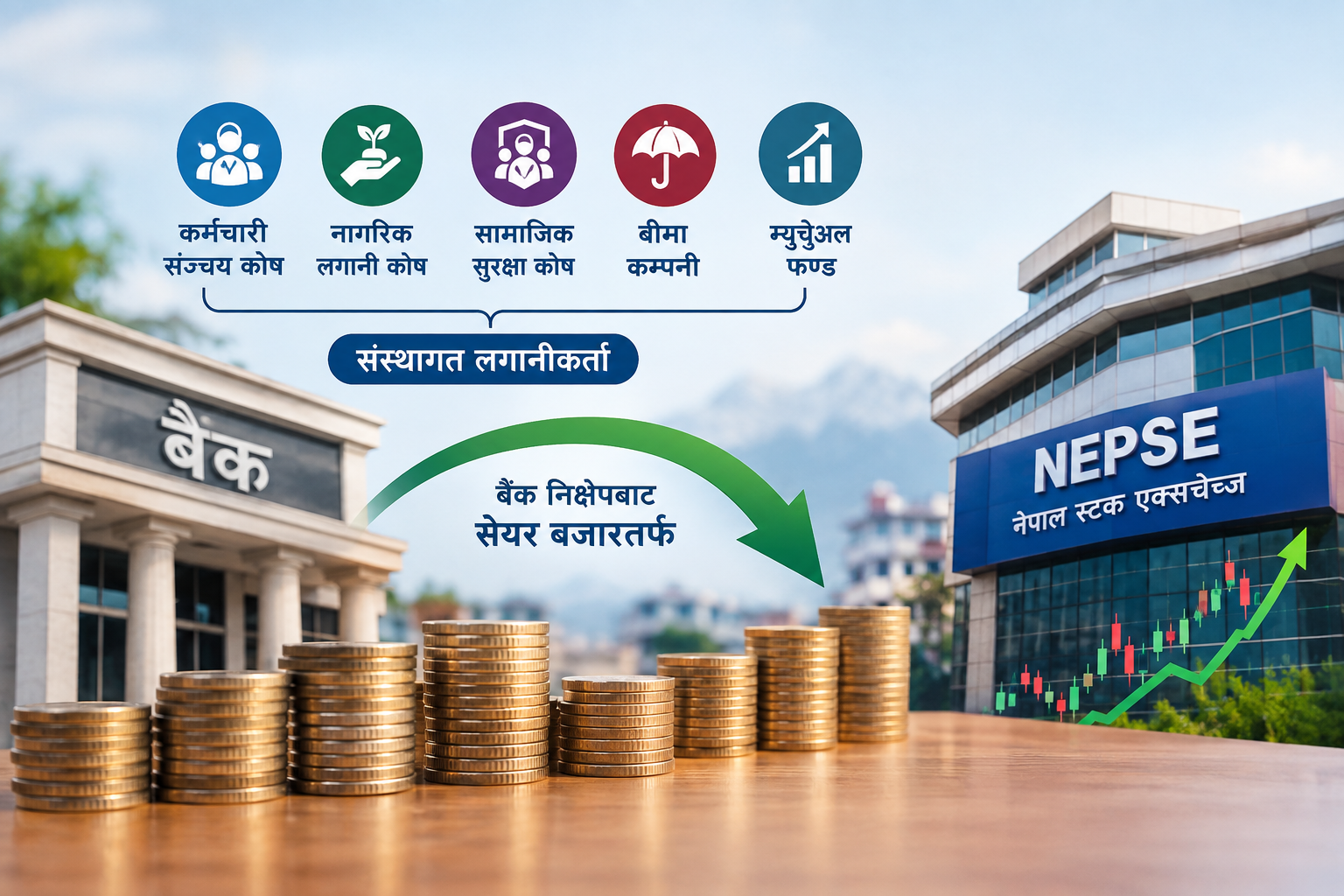
The government’s plan to bring money from provident fund to insurance company to the stock market
Kathmandu. The government has come up with a plan to attract a large proportion of institutional investors like Employees Provident Fund, Citizen Investment Trust, Social Security Fund, Insurance Company and Mutual Fund to the capital market.
The Ministry of Finance has announced to make legal, policy and structural arrangements to rebalance the investment structure of such institutions under the ‘Capital Market Strengthening and Revitalization Action Plan, 2083’.
According to the action plan, necessary policies, rules, directives and transaction infrastructure will be prepared to make institutional investors active in the primary and secondary markets by mid-December 2083. For this, the Securities Board of India (SEBON) will formulate an institutional investment policy and the concerned agencies will revise their investment structure accordingly.
At present, a large part of the Employees Provident Fund, Citizen Investment Trust, Social Security Fund and insurance companies are focused on bank deposits and fixed income instruments. The government aims to increase the flow of long-term institutional capital into the market by creating a conducive environment for such institutions to invest in securities.
According to market analysts, the volatility of the market, which is dependent on individual investors, is expected to be balanced to some extent if the presence of institutional investors increases.
The government will also review the existing limits and risk arrangements related to the investment in the capital market by banks and financial institutions. The Nepal Rastra Bank and the Securities Board of Nepal (SEBON) will jointly review the investment limits, risk weight, collateral adequacy, systemic risk and liquidity provisions by mid-November, 2083.
In addition, banks will be required to have an investment period of at least 45 days to reduce speculative risk on investments made in the secondary market. The government has also proposed changes in the capital gains tax to encourage long-term investment.
According to the action plan, a natural person holding shares for more than 365 days will have to pay only 3.7
5 percent tax, while 5 percent tax will be levied on transactions of one year or less.
Similarly, a plan has been set to study and implement a provision that the loss incurred on the trading of listed securities can be adjusted with the profit made from other securities transactions within the same fiscal year.
The action plan seeks to increase the participation of institutional investors and restructure the bank’s investment policy, tax regime and investment period into a single framework. This indicates that the capital market will move from short-term speculation to long-term investment-oriented structure.

 प्रतिक्रिया दिनुहोस्