

The arrogance of the leaders brought down by Genji: Where are the old parties after a year?
One year of the collapse of the leaders of the big parties: Have the old parties changed?
Anushka Dhami
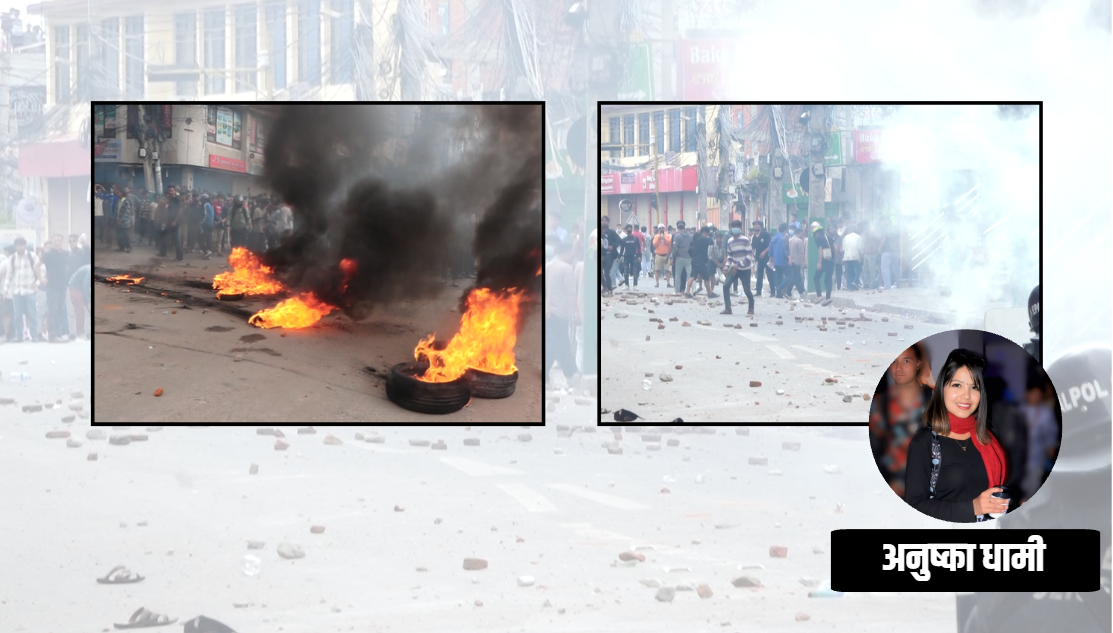
Kathmandu. Today is exactly one year since the big leaders of the big parties were beaten up along with the Jenji movement, their houses were burnt and public structures were destroyed. The Zenji movement brought about a major change in Nepal’s political history and put the old political parties that had been in power for decades on the defensive.
After the then government suddenly banned 26 social networks, the Genji generation took to the streets demanding the removal of the ban on social media. The demonstration, which initially started peacefully on September 23, turned violent after clashes with security forces.
More than
70 people were killed during police repression and clashes with protesters. The protest took a more violent turn after students and youths were shot at and they fell on the streets. On this day of the movement, the anger of the youth spread across the country, due to which incidents of vandalism and arson took place in Singha Durbar, Parliament House, Police Post, Government Buildings and the houses of the leaders. Some leaders were beaten, chased and had to hide to save their lives.
After that, the old political forces of Nepal suddenly became weak and defensive. The leaders of the old parties, who had been at the center of power for years, were dispersed. Many of the top leaders did not even appear in public for a month or two after the Genji movement, but the movement sent a serious message to the old parties that the politics of ignoring the voice of the people is no longer as safe as it used to be.
Today, on the completion of one year of the Jenji movement, the big question is how much of the old political parties of Nepal have internalized the lessons of the movement.
How much have the parties that lost power due to corruption, irregularities, injustice and atrocities changed themselves in this one year?
Today, when we talk about the situation of the four major political parties of Nepal, Nepali Congress, CPN-UML and CPN (Maoist), these three political forces came to power one after the other.
For decades, he decided the political direction of the country and handled the state treasury. But after the Jenji movement, the people asked a new question to the same parties, will you change now or will you repeat the old style again?
First of all, after the Jenji movement, the debate on leadership change within the Congress became intense. After being beaten up by the Jenji in the movement, party President Sher Bahadur Deuba and his wife Arju Rana Deuba left the reins of the party in the hands of Purna Bahadur Khadka and flew abroad for treatment.
Meanwhile, the voice and energy of the youth within the party became stronger. Within the Congress, which had been under the influence of the same leadership for years, voices were raised to bring a new generation to the leadership. Finally, from the 14th general convention, Gagan Thapa reached the leadership of the party and became the president of the Nepali Congress. However, the establishment faction continued to protest by questioning his leadership and the dispute within the party also intensified. But after getting authorization from the Election Commission, the party went to the elections under the leadership of Gagan Thapa. But the Congress could not achieve the expected success in the electoral field. After the Jenji movement, the Rastriya Swatantra Party, which became increasingly popular among the youth, won the election and the Congress lost in many places. Gagan Thapa, who was a contender for the post of party president and prime minister, lost.
But even after the defeat, Gagan Thapa seems to be trying to take the party forward in a new way. Despite the differences between the old establishment faction and the new leadership within the party, Gagan Thapa seems to be positive about uniting the party. Even during the election, Gagan Thapa did not only give priority to his close leaders or old faces, but also tried to give opportunities to new and young faces. This is seen as a sign of the transformation of the Congress.
Now the Nepali Congress seems to be trying to connect itself with the new generation. There is talk of turning the party back to the ideas and democratic values of BP Koirala. Some leaders of the Congress have started admitting that they have remained silent even after seeing corruption, irregularities and wrong practices in the past. They are admitting that they made mistakes in the past and now they should learn from them and move forward.
Even now, the fight for legitimacy is going on in the Congress. It is entangled in its own internal power struggle and parallel convention. Amidst the internal squabbles for 9 months and the legality case pending in the Supreme Court, the establishment and other factions led by Sher Bahadur Deuba have come up with separate schedules for the 15th Congress. The establishment group has brought the schedule of the 15th general convention for September 16, 19, while the other groups have announced a new schedule for the general convention in November. This has brought the Congress to the brink of split.
But the question remains, will the Congress really change with a change of leadership, or does the party’s structure, thinking and political culture also need to change? The CPN-UML is another major political force. In the year 2072, the popularity of UML and KP Sharma Oli was extraordinary. The slogan ‘We love KP Ba’ was heard all over the country. Today, the political hype of KP Oli was also very big at the time of Prime Minister Balen Shah’s political discussion. Under the leadership of Oli, UML achieved remarkable success in the elections. But with time, the political situation changed.
KP Sharma Oli, who was once very popular, is now seen as a critical figure from a large section of the people. From the situation of running away to save his life during the Genji movement to staying away from public programs for the next few months, the UML faced difficult times.
The debate of transformation started within the party. There was talk of leadership change, but after the convention, KP Sharma Oli became the chairman again. Oli is such a leader in Nepali politics, who is known to many as a leader who does not bow down easily. Even after losing power, he did not seem ready to change his style and expression. Instead, his speech and expression repeatedly created controversy. The RSP government was formed after losing to Balen Shah, who was contesting from Jhapa-5 by a huge margin. Sudhan Gurung was appointed as the Home Minister immediately after the formation of the government of the RSP, and the next day he became the Home Minister, KP Sharma Oli was arrested. After Oli’s arrest, UML leaders threatened to launch street protests and made extensive efforts for his release. Later, he was released after the court did not recognize his arrest.
But the voice against him in the UML has not stopped. General Secretary Shankar Pokhrel, who is considered a confidant of Oli, has also not supported him. Pokharel is raising the voice for restructuring in the UML. Chairman Oli has ‘held’ General Secretary Shankar Pokhrel’s proposal to restructure the leadership of the UML through the statute general convention or the general convention. He is calling those who are against him as vagabonds.
Another political competition has also been seen within the UML. Who can speak more on social media, who can write more, who can oppose another party more and who can be more viral. This competition is still going on. But the question is, will writing more on social media restore the party’s public trust?
Even after a year, there is no clear sign that the UML has been able to improve its old image. On the contrary, criticism is increasing within and outside the party. After the Jenji movement, the UML’s attempt to present itself in a new form did not succeed as expected. The UML, which was once one of the most popular political forces in the country, now seems to be struggling to restore its lost public trust. The answer to the question of how much real transformation has taken place within the party according to the message given by the Genji movement is still unclear. Another
major political force was the CPN (Maoist), or the present Communist Party of Nepal.
Although this force was not directly in power during the Genji movement, this party was also under the scanner for corruption, irregularities and irregularities in the past years. During the Genji movement, the houses and private properties of 19 leaders, including the then CPN (Maoist Center) leader Pushpa Kamal Dahal Prachanda, were vandalized, looted and arson. This made one thing clear that the people’s anger was not limited to only one party in power. The people were questioning all the political forces that had run the state in the past.
After the Jenji movement, there was a debate within the Maoist stream on how to make the party a big political force and how to transform it. After that, the campaign for political unity started. On November 3, 2002, the new Nepali Communist Party was formed by merging 10 communist factions including the CPN (Maoist Center) led by Pushpa Kamal Dahal Prachanda and the CPN (Unified Socialist) led by Madhav Kumar Nepal. This can be considered as one of the biggest structural changes that took place in the Nepalese communist movement after the Jenji movement. The Jenji movement put the traditional communist forces on the defensive and forced them to go on the path of megapolarization and transformation. But it is still a big challenge for them to restore the lost trust among the younger generation.
However, after Prachanda’s victory in the election, his political discussion has started increasing again. His experience, political strategy and ability to build organization are still influential in Nepali politics. But Prachanda has also been in controversy from time to time due to his statements. Therefore, the question is the same for the Communist Party of Nepal.
Is changing the name and structure of the party only a transformation, or should the old political culture also change?
After a year of the Jenji movement, the three big parties seem to be in different situations in Nepal’s politics. The Nepali Congress has shown some changes in the direction of leadership and generational change. The UML still seems to be struggling to come out of the old leadership and the old political style. Similarly, the Communist Party of Nepal has tried to build a new political force through unity and restructuring. But the three parties have a common challenge: how to restore the trust of the youth?
Today’s Genji generation doesn’t just want to listen to speeches. They want results. They want transparency. They want real action against corruption. They want opportunities. And most importantly, they do not consider themselves to be the spectators of the political games of the old leaders, but to be the decision-makers of the future of the country. It has been a year since the Genji movement, but the questions raised by the movement are still alive. Have the old political parties of Nepal really changed? Or have only the faces changed?

 प्रतिक्रिया दिनुहोस्