

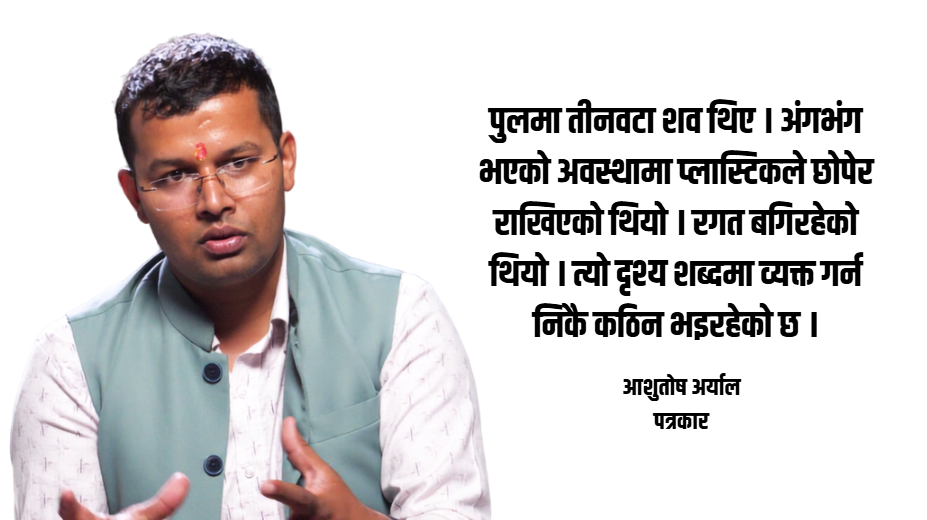
Ashutosh Aryal
Journalist
Bhotekoshi Floods: The reality is different from the horrific scenes on social media
Disaster, pain and the state: ‘The scene of a bleeding corpse made me emotional’
Kathmandu. The pictures and videos of the Bhotekoshi floods seen on social media had indicated that a big disaster had occurred in the settlements around Rasuwa and Trishuli. But the distance between the scene on the screen and the actual situation of the disaster is very different. To understand this difference, Nepal News Bank talked to journalist Ashutosh Aryal, who reached the affected areas within a few hours of the floods.
In which the scene that Aryal saw during field reporting in the flood-affected areas was not just a story of swept houses, buried roads and collapsed bridges. It was also a story of the pain of losing the property that he had acquired all his life, the confusion of displacement, the wait for relief and the expectation of the state.
On the day of the flood, i. e., on August 26, at around 1 pm, the team along with Aryal left the Kathmandu Valley for the affected area. While going down from Nagdhunga, the police advised not to go ahead due to the risk. But after showing the press pass, the team went ahead after informing them that they were going for reporting.
After crossing Khanikhola, Mahadevbesi, Galchhi and other places, the team reached Galchhi Rural Municipality-Baireni Bazaar of Dhading. Houses were buried by mud in Baireni. The condition of the road was such that it was not possible to move forward by normal vehicles.
When the team saw the JCB being used in the construction of the road, the team asked for permission to climb on it and reach the affected area. After the contractor gave permission, the team moved forward sitting in the JCB bucket.
‘People were coming down from above in fear. They were saying that they had saved their lives. Some people were asking them to use JCB to remove the sand accumulated in their houses,” Aryal recalls.
Some of the affected people were brought to a safe place with the help of the same JCB. Their condition was the same, their lives were saved, but everything was lost.
The house was submerged. The belongings were buried. The fields were filled with mud. There was no place to stay. Even though they were saved from the disaster, they were confused about where to go next.
He says, “We brought some of the affected people to a safe place with the help of the same JCB. Their condition was the same, their lives were saved, but everything was lost.” The house was submerged, the belongings were buried, the fields were filled with mud. There was no place to stay. Even though their lives were saved, the confusion and fear of where to go was clearly visible on their faces. ‘
People who reached the bridge in search of relatives
From Baireni, the team proceeded towards Nuwakot. Looking down from a bridge over the Trishuli River, we could see a crowd of people. Some had come to see the damage caused by the floods, some were looking for relatives.
“My house was washed away, I couldn’t find my people, I found people trying to see if I could see them here,” Aryal says.
While talking to the local people’s representatives and the police, the security personnel deployed in the rescue gave information about how the people were saved from the flood. They said that the locals were alerted by miking and those who were at risk were rescued.
The team then proceeded towards Nuwakot via Trishuli and on the way to Betrawati and Syaphrubesi.
After reaching the bridge over Kolpu Khola on the border of Dhading and Nuwakot, the team had to face another challenge. Due to the direct impact of the flood in the Trishuli River, the bridge over Kolpu Khola was also bent. Police were deployed on the bridge. Vehicular movement was stopped.
Locals had created a situation to cross the dangerous bridge with the help of wood and stones swept away by the floods. The team also moved forward by taking the same risk.
‘We were gone, but we were afraid that we would not be able to return. If something happened on the bridge, we would be stuck there,” Aryal recalls.
The pain caused by the three bodies
The most tragic scene for Aryal was in the same Kolpukhola area. Three bodies were kept near the bridge. The police brought the body to the side of the road and covered it with plastic. Blood was oozing from the body. The team found that one of them was a pregnant woman.
‘There were three bodies on the bridge. They were covered with plastic in a mutilated state. Blood was flowing. It is very difficult to describe that scene in words,” says Aryal.
According to him, even though it was his responsibility as a journalist to take the scene and disseminate information, there was a strong feeling that in terms of humanity, he should have helped to bring the bodies to a safe place. But at that time, he says that he could not do much even if he wanted to because he did not have the necessary means and conditions.
‘I saw such a scene for the first time in my life. It was a very painful moment,” he recalls.
Rescue, Relief Arrived Late
Aryal feels that in the initial days of the floods, the federal government’s attention was mainly focused on rescue. The local governments, however, started relief and temporary management according to their capacity.
He said that the Galchi Rural Municipality held an executive meeting on the day of the flood and decided to provide emergency relief of Rs 10,000 per person to the affected people. Belkotgadhi Municipality had made preparations to temporarily accommodate homeless and displaced families in schools. However, he feels that it took a few days for relief to reach the affected settlements.
“For the first two-three days, the affected people were complaining that they could not eat and were staying in others’ houses. In some villages, relief was available only after the fifth day,” he said.
According to him, there was a lack of coordination between rescue and relief management. He believes that the local machinery could not be adequately mobilized in the distribution of relief sent from the center.
Hope
Amid the disaster, there is also a lot of hope among the affected people towards the media. When the journalists of Kathmandu reached the affected areas, they were hoping that their problems would reach the state and get relief. But in recent times, the tendency to present the pain on social media for views and TRP has affected the trust in the media.
“Some of the victims complained that they were here for views rather than to show us our problems,” he said.
According to him, the horrific scenes of the floods immediately went viral on social media, but the real-life story of the victims has been overshadowed.
Who had a house, how many generations had been living there, how much land was there, how many members were there in the family, what was their basis of livelihood, how much did the flood affect their income? He believes that there is not enough reporting on such questions.
“My house was swept away, my land was washed away, I became a squatter. But we did not dig deep into how much land that person had, how his family was, how he used to earn a living,” he said.
The distance between social media and reality
According to Aryal, the visuals seen on social media are only a part of the disaster. It is difficult to understand the daily life, occupation, psychological state and future concerns of the people living in the affected areas from such videos.
He has seen instances of victims going to the house after the floods to steal the leftovers and putting them up on social media with the intention of stealing them. According to him, such content causes more social damage to the victims.
Similarly, he says that the tendency to limit the bodies of people swept away in floods to the news of ‘bodies found here’ without analyzing them with statistics does not show the real picture of the disaster.
The pain of losing his own people
This reporting was not easy for Aryal personally. He got the news of the loss of his acquaintances in the floods.
According to him, the family of Manisha Rijal, who studied in the same school in Dhading, was two batches junior to her. Similarly, Basu Acharya, who studied Plus Two with him, was able to survive on the banks of the floods.
“The most painful thing is the disappearance of my neighbour’s sister’s family. I still wonder if she is alive,” he says.
14 km on foot
The team had to travel very difficult for the first two to three days to understand the situation in the affected areas. Aryal said that the report was also done by crossing the bridge of Trishuli and walking about 14 kilometers in the area on the other side of the river.
Efforts were made to understand the condition of the affected people by reaching the affected settlements amidst the muddy road, the night setting and the fear all around.
‘When we arrived, they were afraid that the state would not do anything. Houses and fields were washed away. But we wanted to go higher and understand the situation,” he said.
should not be kept in the same basket
According to Aryal, the rehabilitation of the flood victims is not possible with the same structure. He suggested that a relief and rehabilitation plan should be made according to the nature of the damage.
He said that sanitation, river control and safe housing should be provided to the families whose houses have been buried or damaged.
He said that for the families who have lost their homes, land and jobs, the problem will not be solved only by constructing houses or providing land.
“If jobs are lost, jobs should also be created. It is not enough just to build houses,” he said.
He said that alternative ways of income generation should be found by studying what can be done in the future in the fields buried with sand and mud brought by Trishuli. He also suggested developing an alternative tourism route as the tourism route has been damaged due to floods.
Challenges ahead: Settlements and roads on the banks of the river
Floods have also exposed the risk to the roads and settlements on the banks of the river. He said that the damage could be even greater if such disasters recur in the future as houses and businesses are operating on the banks of the river within the boundaries of highways and roads.
“It cannot be said that such a catastrophe will not happen again. There is a need to have clear criteria on which area to settle, where to do business and where to build highways,” he said. He also suggested that the risks of constructing roads on the banks of the river should also be taken into account.
Need to stop further erosion
Aryal said that erosion is continuing in some areas around the Trishuli River even after a long time of floods. He said that work should be started immediately to stop river erosion to prevent further damage in various settlements of Dhading and Nuwakot districts.
“Erosion is still going on in some places. If prevention work is started immediately, more homelessness can be prevented,” he said.
For him, the flood reporting of Rasuwa-Nuwakot-Dhading was not just news of a disaster. It was also an experience of rethinking the state’s rescue mechanism, relief distribution, role of local government, responsibility of media and use of social media.
The flood not only swept away the houses, farms and businesses for many, but also the basis of life that had been connected for generations. Therefore, the question will not be limited to immediate relief, Aryal concluded. He believes that the main challenge is to plan how to rehabilitate those who have lost and prevent another disaster from happening in the same place again.



 प्रतिक्रिया दिनुहोस्